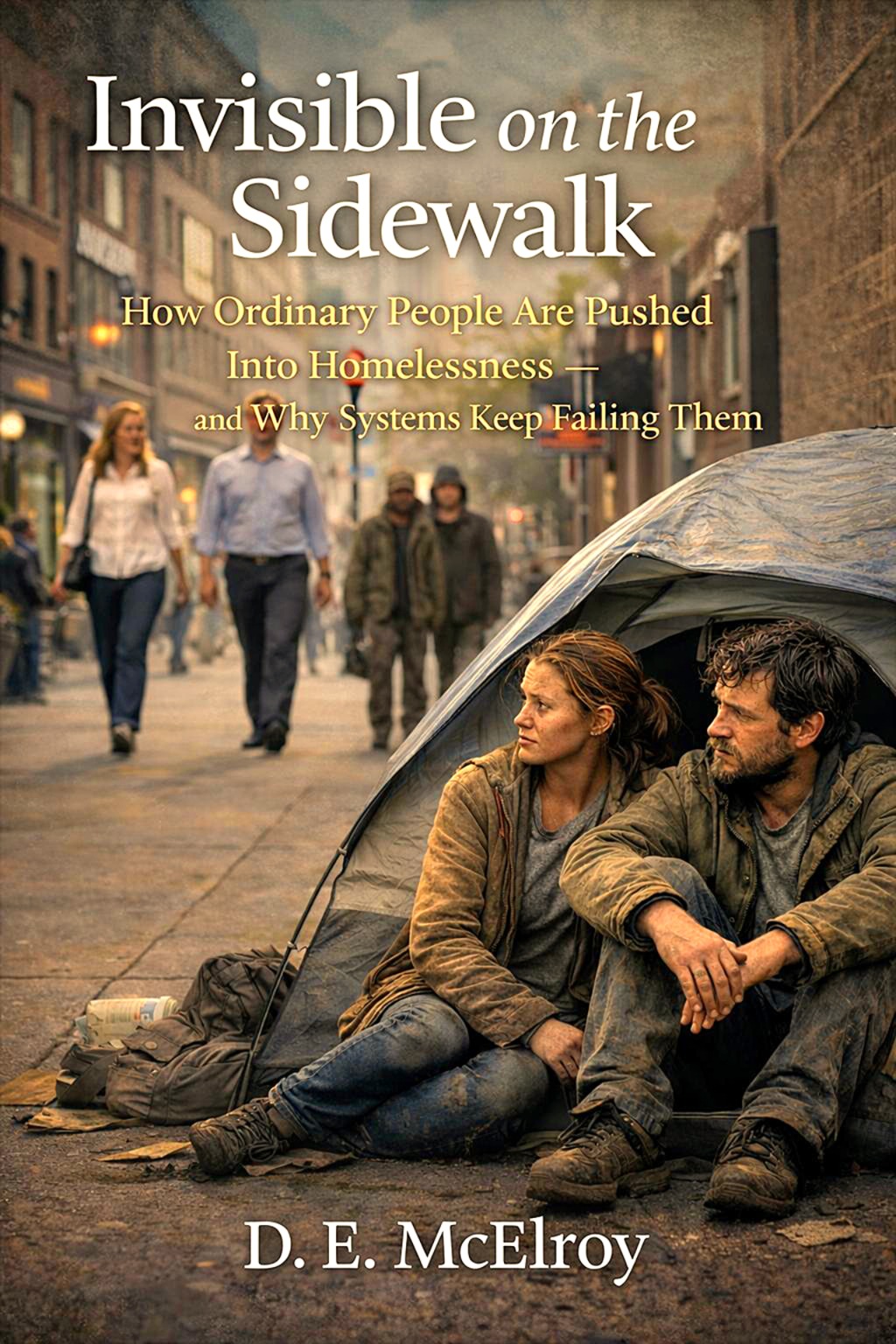
By
D. E. McElroy
Homelessness in the modern Western world has become so visible that many people feel overwhelmed by it. Some feel anger. Some feel helplessness. Some feel numbness. And many feel what I would call moral grief—the pain of witnessing suffering that should not be normal.
This book focuses on a simple, uncomfortable truth: regular, hardworking, honest people can end up on the streets faster than most of us want to admit. When support systems are complicated, inconsistent, or quietly ineffective, a temporary crisis can turn into a life-altering collapse.
I will not point to specific agencies, names, or partisan labels. Instead, I will describe repeating patterns—because patterns reveal what a system does in real life, not what it promises to do in speeches or press releases.
A gentle call to awareness (not a call-to-action): As you read, notice where your own mind tightens or shuts down. Not to judge yourself—only to see clearly. Clear seeing is a form of compassion.
1. The New Normal Nobody Asked For
4. Why Help Often Feels Like a Maze
5. The Money Question, Without Accusing Names
6. Housing as a Battlefield of Pressure
7. The Moral Injury of Seeing and Doing Nothing
8. What Actually Helps People Return
9. A Quiet Spiritual Lens, Without Forcing Belief
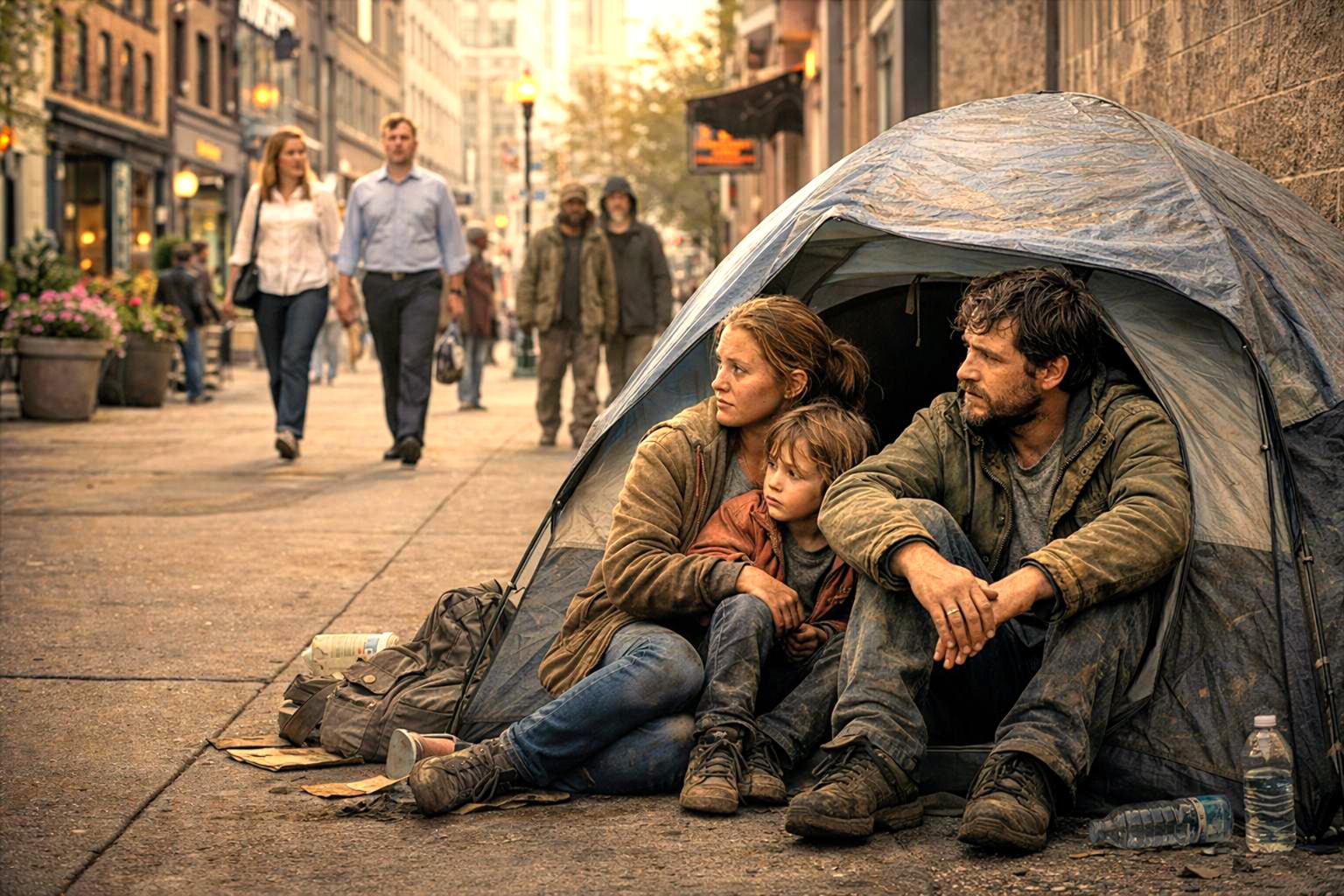
Walk through almost any major city in the Western world and you will see what once seemed “unthinkable”: tents, sleeping bags, people living in cars, and human beings trying to survive in plain sight. This is not a rare emergency anymore. It is a steady background noise—so constant that many people stop noticing it, not because they are heartless, but because the mind can only carry so much grief at once.
Homelessness is often described as a “problem,” but that word can hide the truth. It is a human crisis made visible. It is also a mirror that reflects how a society treats people when they slip. The cruel part is that many who fall are not “outsiders” at all. They are workers, caregivers, veterans, teachers, and people who once paid rent on time—until one bad season became a cascade.
This book is not written to blame one office, one party, one leader, or one program by name. It is written to look at patterns—because patterns are where reality hides. When the same outcomes repeat for decades, across different administrations and budget promises, it is fair to ask: what is the system actually designed to do, and what is it quietly allowed to fail at doing?
Many people imagine homelessness as a separate world that happens to “other people.” In truth, the line between housed and unhoused can be thinner than a paycheck. A medical bill, an injury, a divorce, a job cut, a rent increase, a family crisis, a car breakdown, or one missed month can start a chain reaction. Once you miss rent, you often pay a penalty. Once you pay a penalty, you fall behind again. And then the door closes fast.
For the working poor, there is often no cushion. Savings are small or nonexistent. Credit is expensive. Family support may not be available. And if someone already carries anxiety, depression, or trauma, the stress of instability can push them into a place where clear thinking becomes difficult. That does not mean they are “weak.” It means the nervous system is overloaded.
One of the most misunderstood realities is how quickly homelessness can “teach” a person the wrong lessons: sleep lightly, trust nobody, eat whatever you can, stay moving, hide your pain, and do what you must to get through the night. These are survival rules. But they can also become a trap that makes it harder to return to stable life.
Street life is not simply “living outdoors.” It is exposure to danger, humiliation, and constant stress. People can be robbed, assaulted, exploited, or pulled into conflicts they did not choose. Weather becomes an enemy. Sleep becomes a risk. Hygiene becomes a daily battle. And simple tasks—charging a phone, keeping documents dry, finding a bathroom—can become major obstacles.
Under these conditions, the body changes. Chronic stress raises tension, reduces patience, and increases reactivity. It can worsen mental health symptoms and make substance use more likely—not because people “want to be addicts,” but because pain demands relief. When there is no safe room, no stable schedule, and no reliable support, relief often comes from whatever is available.
The street also changes how society sees a person. A housed person who is struggling is often called “going through a rough patch.” An unhoused person is often called “the homeless.” That label can erase their name, history, and humanity. Once a person is treated as invisible, many systems begin to act as if their suffering is acceptable collateral.
Many communities have services—hotlines, shelters, caseworkers, forms, appointments, and programs. On paper, it can look like a strong safety net. On the ground, it can feel like a maze with locked doors. People may be told to call a number that never answers, to wait for a list that does not move, or to bring documents that were lost on the street. The system can be “available” while being practically unreachable.
Even when help is offered, it may be conditional in ways that do not fit reality. Some shelters are full. Some are unsafe. Some require people to leave early every morning. Some separate families. Some exclude pets—the one relationship keeping someone emotionally stable. Some demand strict compliance without recognizing that trauma and exhaustion reduce a person’s ability to comply.
The hard truth is that a system can look
compassionate while quietly operating like a filter: it helps
the easiest cases first. That is not always intentional. But it
happens when the process is designed around paperwork,
appointments, and perfect behavior—rather than around the
chaotic reality of crisis.
When the public hears that “millions” or “billions” were allocated, people assume there will be visible results. When results do not appear, frustration builds. Many ordinary citizens suspect waste, mismanagement, or corruption. Sometimes those suspicions are correct. Sometimes the problem is more subtle: layers of contracts, administrative overhead, poor coordination, and incentives that reward process over outcome.
A key insight is this: in many systems, failure is not punished the way it should be. If a program does not meet goals, the explanation can be “the problem is complex,” followed by a request for more funding—without a clear accounting of what worked and what did not. Complexity becomes a shield. And when complexity becomes a shield, trust collapses.
This book avoids pointing at specific people for a reason: the deeper issue is structural. If the structure allows money to move without measurable impact, then new money will follow the same path. The public is not wrong to feel angry. But the most useful anger is the kind that asks for transparency, measurement, and accountability—without turning into hate.
In many areas, housing has become a pressure system: rents rise faster than wages, and the gap is paid with stress. People work harder, sleep less, and still fall behind. When a city becomes unaffordable, homelessness is not a mystery—it is math. A society can only squeeze so long before people spill out of the system.
Add in the reality that some jobs are seasonal, some are unstable, and some pay just enough to keep a person barely functioning. One missed week can become a missed month. If eviction follows, the person’s record becomes a barrier to future housing. This creates a cruel loop: the very event that made someone homeless becomes the reason landlords reject them.
What is most painful is when “good people”—the ones who show up for work, help others, and try to live honestly—end up sleeping in cars. That is not a moral failure. It is a sign that the economic floor is cracking.
Many people feel a quiet grief when they see tents, elders, and families on sidewalks. They feel helpless, and helplessness often turns into numbness. This is not because people do not care. It is because the heart cannot stay open without some pathway to action or meaning. When there is no pathway, the mind protects itself by shutting down.
This “moral grief” can also appear as anger—at government, at neighbors, at the unhoused, at the world. But underneath the anger is often a simple pain: it should not be like this. When a society normalizes suffering, it damages everyone’s inner life, not only the lives of those on the street.
A gentle approach is needed here. Shame does not solve homelessness. Hatred does not solve homelessness. Even blame does not solve homelessness unless it leads to better design. What helps is clear seeing—paired with human compassion and honest questions.
People return to stable life when a few basics become reliable: safety, sleep, hygiene, food, medical support, and a realistic path to housing. The order matters. A person cannot “think their way out” of crisis while living in constant threat. Stability is often the medicine that allows healthier choices to reappear.
Help works best when it is simple and continuous: one point of contact, clear steps, and follow-through. When a person must retell their story to ten offices, trauma deepens. When help is fragmented, people fall through cracks. The goal is not perfect programs. The goal is a human path that a stressed person can actually walk.
This is also where community matters. Many people need a bridge back: someone who treats them like a person, not a case number. In a healthy society, the unhoused are not “outside” of us. They are part of us, temporarily in a harder chapter.
Many readers of WCM understand life through the lens of consciousness, soul growth, and near-death experience accounts. From that view, human life is a place of contrast—where compassion is tested and expanded. But even if one holds that view, we do not have to romanticize suffering. Pain is still pain, and a hungry person is still hungry.
A helpful spiritual lens is not one that excuses neglect. It is one that widens the heart. If souls learn through love, then homelessness is a direct invitation to reclaim human dignity—both in the person who needs help and in the person who decides whether to look away.
Whether or not the world was “planned,” we still choose who we become inside it. A society is not judged by its slogans. It is judged by what it tolerates quietly.
This is not a call to rage, and it is not a call to despair. It is a call to awareness. Notice what you see. Notice what you have learned to ignore. Notice the language people use to make suffering feel normal. And notice the small ways compassion can return: a conversation, a respectful glance, a local question asked with humility, a vote for transparency, a refusal to accept endless excuses without results.
Homelessness is not only an economic issue. It is a dignity issue. When dignity collapses, everything collapses with it—health, safety, family, and hope. And when a society allows dignity to collapse for some, it slowly weakens dignity for all.
If this book does only one thing, let it do this: restore the truth that homeless people are not “a problem.” They are people. Many are ordinary people who fell through a system that should have caught them. Seeing that clearly is the beginning of any real solution.
D. E. McElroy is an independent researcher, writer, and lifelong observer of how power, policy, and public narratives shape human life. His work at World Christianship Ministries (WCM) explores spirituality, consciousness, and practical compassion—especially where systems fail ordinary people.
McElroy’s writing emphasizes clarity over slogans, dignity over blame, and human reality over public performance. His work is hosted at wcm.org.