Home Page
NDE Near Death Experience
Page
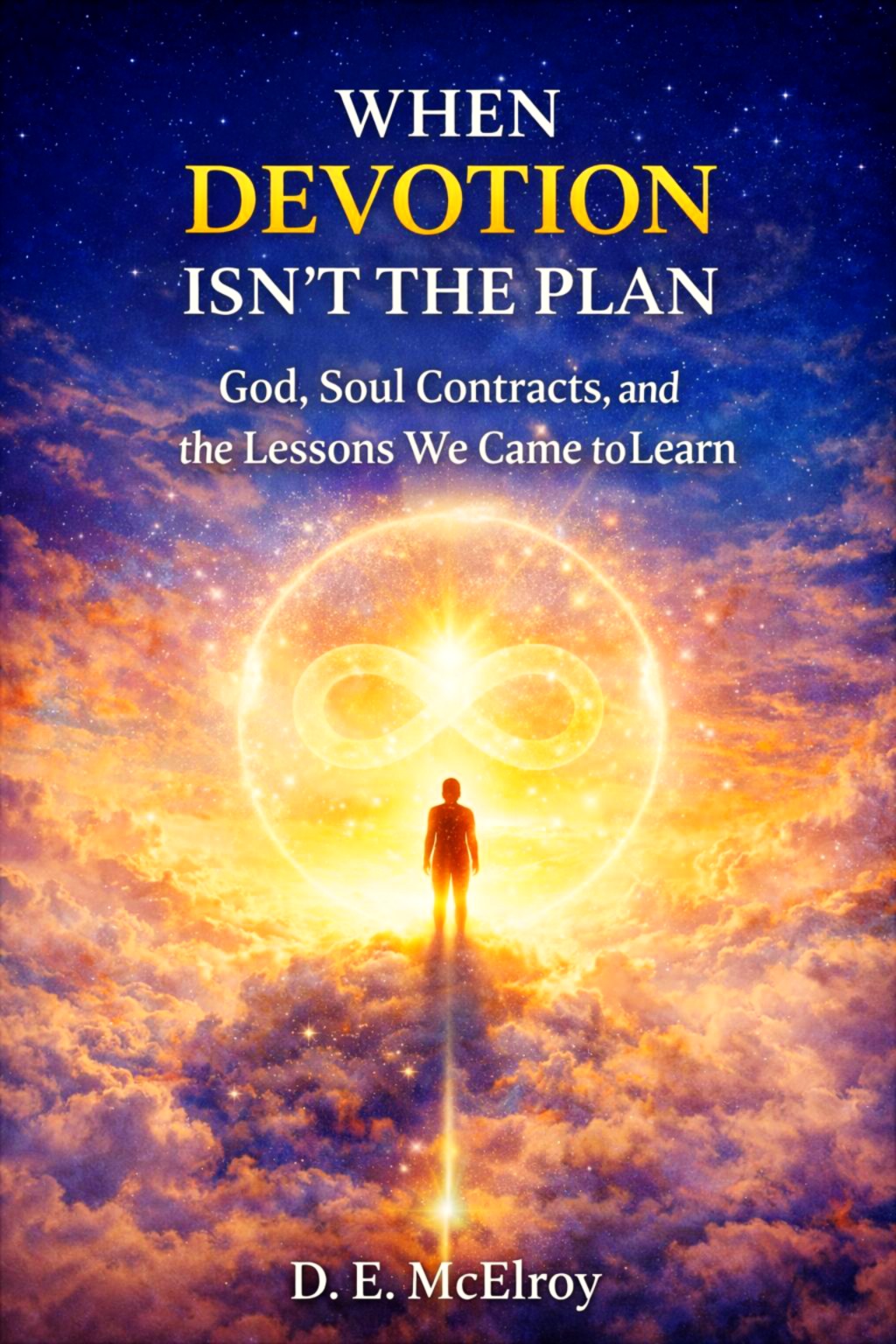
WHEN DEVOTION ISN’T THE PLAN
God, Soul Contracts, and the Lessons We Came to Learn
Introduction
Many sincere and well-meaning people are taught that the highest spiritual goal in life is to devote oneself completely to God. It sounds noble. It sounds humble. It sounds holy.
And for some souls, it may be exactly right.
But what if that message—when applied universally—misses something essential about why we come to Earth at all?
This book began with a simple phrase spoken with heartfelt sincerity: “Devoting our life to God.” Those words triggered a deeper question—one that rarely gets asked openly:
Across cultures, religions, and centuries, devotion has often been framed as submission, surrender, obedience, or service. God is portrayed as a king, a ruler, or an authority to whom loyalty must be pledged. This model has shaped prayers, rituals, and entire belief systems. Yet it also raises a quiet but profound tension:
If our souls are expressions of God—emanations of divine consciousness—then who, exactly, is being devoted to whom?
Near-death experiences, mystical traditions, and modern spiritual inquiry increasingly suggest that souls come into physical life with specific intentions. These are sometimes called soul contracts or life plans: agreements to learn certain lessons, face particular challenges, develop qualities like courage, compassion, independence, creativity, or discernment.
In that context, unquestioning devotion can sometimes interfere rather than help.
A soul whose purpose is to develop inner authority may lose itself in obedience. A soul meant to explore discernment may silence its questions. A soul here to experience contrast may bypass growth through premature surrender.
This does not mean devotion is wrong. It means devotion is contextual.
For some, devotion is the lesson. For others, devotion is the distraction.
This book is not an attack on religion, faith, or God. It is an invitation to look more carefully at why we are here, what the soul is, and whether one spiritual posture can truly serve every incarnation.
We will explore how devotion developed historically, how near-death experiences describe God differently than traditional theology, and why honoring one’s soul plan may sometimes require not devoting one’s life away—but living it fully.
The question is not whether God deserves devotion. The question is whether your soul came here to give it.
Chapter 2- What Religions Mean by “Devotion”
Across the world’s major religions, the word devotion carries deep emotional and spiritual weight. It suggests loyalty, reverence, humility, and love. For many believers, devotion is not just an attitude—it is an identity. One does not merely believe in God; one belongs to God.
Yet when we look closely, devotion has rarely meant the same thing across time and cultures. What unites these meanings is not God’s nature, but human interpretations of authority, hierarchy, and relationship.
In many religious traditions, devotion developed alongside social structures that were already familiar to people: kings, emperors, lords, and masters. God was framed using the highest authority humans understood. As a result, devotion often came to mean obedience, submission, and loyalty to a supreme ruler.
In ancient societies, this made sense. Survival depended on order. Questioning authority could mean exile or death. Religion reinforced stability by presenting God as the ultimate king—one whose commands were absolute and whose favor was essential.
Over time, devotion became intertwined with fear and reward:
- Obedience brought blessings.
- Disobedience brought punishment.
- Loyalty ensured protection.
- Doubt was dangerous.
Even in more compassionate religious expressions, devotion often meant placing God above the self, the body, the mind, and sometimes even conscience. The ideal devotee was selfless, surrendered, and unquestioning.
But this raises an important issue rarely addressed:
As religions spread, devotion also became a way to measure spiritual worth. Those who devoted more time, energy, or sacrifice were seen as closer to God. Saints, monks, nuns, ascetics, and martyrs became spiritual role models, reinforcing the idea that the less one lived for oneself, the more one pleased God.
Yet this framework assumes something critical: that the human self is separate from God—and must be overcome.
Mystical traditions within many religions quietly challenged the dominant devotion model. They spoke of union rather than submission, intimacy rather than hierarchy, and inner knowing rather than external authority. These voices often existed at the margins—sometimes celebrated, sometimes persecuted—because they disrupted the power structure embedded in devotional systems.
In modern times, devotion is often softened. It may be described as love, service, gratitude, or surrender to divine will. Yet the underlying assumption frequently remains the same: God is separate. Humans are subordinate. Devotion bridges the gap.
This assumption works well for some souls. It resonates with those whose inner calling is humility, service, or surrender.
But it does not work for everyone.
A soul that came to learn discernment may feel conflicted. A soul here to develop autonomy may feel diminished. A soul meant to explore creative expression may feel constrained.
When devotion becomes a universal expectation rather than a personal calling, it stops being sacred and starts becoming prescriptive.
Understanding what religions mean by devotion is not about judgment. It is about clarity. Only when we see how devotion has been defined—and why—can we begin to ask a deeper question:
Is devotion a spiritual truth… or a spiritual role?
And if it is a role, who is it meant for?
Chapter 3 - When God Was Treated Like a King
Long before devotion became a personal spiritual choice, it was a political necessity.
In the ancient world, survival depended on hierarchy. Kings ruled by force, lineage, or divine claim. Obedience was not optional—it was the difference between life and death. When religions formed within these societies, they naturally reflected the same structure. God was not imagined as an abstract source of consciousness or love, but as the ultimate monarch.
God became the King of Kings.
In ancient Egypt, the pharaoh was not merely chosen by the gods—he was divine. To serve the pharaoh was to serve the cosmic order itself. Loyalty was sacred, rebellion was sacrilege, and devotion to the divine was inseparable from obedience to earthly power. Religion reinforced the state, and the state reinforced religion.
In Mesopotamia, kings ruled by divine mandate. Law codes were presented as gifts from the gods, not human decisions. Obedience to law was obedience to the divine will. Devotion meant alignment with authority, not personal spiritual insight.
This pattern repeated across civilizations.
In the Roman world, emperors were eventually declared divine. Citizens were required to offer acts of devotion—burning incense, pledging loyalty—not as personal faith, but as proof of allegiance. Refusal was seen as political rebellion. Early Christians were persecuted not primarily for belief, but for withholding devotion from the emperor.
Devotion was loyalty. Loyalty was survival.
As empires rose and fell, the image of God as ruler only grew stronger. When monotheistic religions expanded, they inherited the same framework. God became supreme lawgiver, judge, and sovereign ruler of the universe. Heaven mirrored imperial courts. Angels became messengers and soldiers. Souls were subjects awaiting judgment.
In medieval Europe, this model reached full maturity. Kings ruled “by divine right.” The Church crowned monarchs, and monarchs protected the Church. God ruled heaven; kings ruled Earth. Questioning either was dangerous.
Devotion during this period meant submission: submission to God, submission to Church authority, and submission to social hierarchy.
Spiritual virtue was measured by obedience, humility, and self-denial. Saints were praised for surrendering personal will. Monastic life was elevated as the highest calling because it mirrored complete devotion to the divine ruler.
Meanwhile, those who questioned authority—mystics, reformers, visionaries—were often accused of heresy. Not because they denied God, but because they challenged how God was framed. A God encountered directly within the soul threatened a system built on external authority.
This ruler-based model was not limited to the West. In ancient China, the emperor ruled under the “Mandate of Heaven.” Cosmic order depended on obedience to hierarchy. Heaven, Earth, and society mirrored one another. Devotion reinforced harmony—but always through submission to authority.
Across cultures, devotion became less about relationship and more about alignment with power.
When God is treated like a king, the soul is treated like a subject.
Subjects do not question their purpose. Subjects do not negotiate their role. Subjects exist to serve the will of the ruler.
But incarnation is not servitude.
If souls were merely subjects, there would be no need for individuality, diversity, or lived experience. A universe of obedient extensions would require no growth, no contrast, and no learning.
And yet, human life is filled with complexity: conflicting desires, moral ambiguity, emotional depth, creative expression, and personal struggle.
These are not the traits of subjects following orders. They are the traits of participants learning through experience.
The king-based God model also introduced a troubling contradiction. If God is all-knowing and all-powerful, why require devotion at all? Human kings demand loyalty because they are fragile—threatened by rebellion, loss of control, or collapse. An infinite divine intelligence would have no such insecurity.
So why the insistence on submission?
The answer may lie less in God’s nature and more in humanity’s. A ruler-based God simplifies uncertainty. It provides rules instead of discernment, obedience instead of responsibility, and authority instead of inner guidance. For societies struggling with chaos, this was stabilizing.
But for souls whose purpose involved autonomy, creativity, or inner authority, the king model became constraining.
Devotion, once a survival strategy, hardened into doctrine. And doctrine, once unquestioned, became sacred.
Understanding this shift does not diminish spirituality. It restores context. It reminds us that how God was portrayed often reflected human systems of power, not divine necessity.
When devotion is rooted in a king-subject relationship, it assumes that the highest spiritual act is surrender.
But what if the highest act for some souls is experience?
What if incarnation is not about kneeling before God—but about expressing God through lived life?
If so, devotion to a ruler may sometimes pull a soul away from its true assignment.
Chapter 4 - What Near-Death Experiences Actually Show
When people return from near-death experiences, they often struggle to describe what they encountered—not because it was frightening, but because it did not match the religious framework they were taught.
Across cultures, belief systems, and personal backgrounds, near-death experiences (NDEs) consistently describe a reality beyond the body that is not hierarchical. There is no throne, no court, no demand for loyalty, and no requirement to kneel.
Instead, experiencers encounter an overwhelming sense of presence, intelligence, and unconditional love.
They do not meet a ruler demanding devotion. They encounter a consciousness that already knows them completely.
Again and again, people report that God—or Source, or the Light—is not experienced as separate from them, but as something deeply familiar. Many describe it not as someone they face, but as something they return into. There is no sense of superiority or inferiority.
And perhaps most surprising of all: There is no judgment.
Instead of being evaluated by an external authority, experiencers often describe a life review. But this review is not punitive. It is experiential. They feel the emotional impact of their actions from the perspective of others—not to shame them, but to help them understand.
One brief example illustrates this clearly. A woman who had no strong religious beliefs described entering a brilliant, loving presence after a medical crisis. Expecting judgment, she instead felt a profound sense of acceptance. During her life review, she noticed moments where she had abandoned her own needs out of obligation. She felt no condemnation—only a gentle realization that she had not fully lived. The message she returned with was simple: “You came to experience life, not disappear inside it.”
Many experiencers report awareness that life was chosen, not assigned. Before incarnation, they sensed reviewing possible challenges, relationships, and lessons. Life was approached as an opportunity, not a test of loyalty.
This is where the idea of soul plans or soul contracts naturally emerges—not as rigid scripts, but as intentions. Souls appear to come into life to explore specific qualities, such as learning compassion without self-erasure, developing courage through uncertainty, discovering discernment rather than obedience, expressing creativity without permission, and balancing connection and autonomy.
None of these require devotion in the traditional religious sense. In fact, some would be undermined by it.
Near-death experiences consistently suggest that what matters is not how devoted a person was, but how honestly they engaged with life.
Love is not earned. It is assumed. Love is not a reward for obedience. It is the environment in which growth occurs.
If God already knows itself completely, incarnation is not for God’s benefit. It is for experience itself. Devotion serves no functional purpose for an infinite intelligence—but experience does.
This does not invalidate devotion as a soul path. Some souls may choose a life centered on surrender, service, or devotion as their lesson. But NDEs strongly suggest that devotion is one option among many, not a universal requirement.
God does not want to be worshiped. God wants to be experienced through life.
And if souls come here with intentions, we must ask: how do we recognize when devotion aligns with the soul plan—and when it does not?
Chapter 5 - The Soul Plan
If near-death experiences reveal anything consistently, it is this: Life is intentional.
Souls do not arrive randomly, nor do they incarnate simply to prove loyalty or devotion. Instead, they come with purpose—often subtle, sometimes challenging, and almost always misunderstood from within the human perspective.
This purpose is commonly referred to as a soul plan or soul contract.
A soul plan is not a rigid script. It is not a checklist of events that must occur, nor a fate that cannot be altered. Rather, it is an intention: a set of themes, qualities, or experiences the soul wishes to explore through physical life.
Think of it less like a command and more like a curriculum.
Some come to explore compassion. Others independence. Some courage. Others boundaries. Some choose lives of service. Others choose lives of contrast, tension, or uncertainty. What matters is not the form the life takes, but what is learned through it.
From this perspective, devotion is not inherently virtuous or flawed—it is situational. It depends entirely on whether devotion aligns with the soul’s chosen lessons.
For a soul whose intention is humility, surrender, or service, devotion may be deeply fulfilling. It may feel natural, expansive, and aligned.
But for another soul, devotion may feel constricting, confusing, or even painful.
A soul that came to learn self-trust may struggle under obedience. A soul here to develop inner authority may feel diminished by surrender. A soul exploring individuality may feel lost when told to dissolve itself into devotion.
Here is how this often looks in everyday life. Imagine a person who feels deeply drawn to creativity—art, writing, music, or innovation. From childhood, they feel alive when expressing ideas and perspectives uniquely their own. But they are taught that the highest spiritual path is to suppress personal desires and devote themselves entirely to service or obedience. They try—and instead of peace, they feel numb or disconnected. They assume they are failing spiritually. But what if their soul came here to express something into the world—something that cannot emerge through submission alone?
This inner friction is often misunderstood. People are told that resistance to devotion means ego, rebellion, or spiritual immaturity. But from a soul-plan perspective, resistance may actually be guidance.
Religion works best when it is chosen, not imposed—and so does devotion.
Recognizing the soul plan means asking not, “What should a good believer do?” but rather: “What did my soul come here to learn?”
When devotion aligns with that answer, it is transformative. When it does not, it can quietly derail a life.
And that leads to an even deeper question: if we are expressions of God itself, then what does devotion even mean?
Chapter 6 - If We Are Part of God, Who Is Being Worshiped?
If God is the source of all things—and if the soul comes from God—then what exactly is happening when a soul devotes itself to God?
Most devotional traditions depend on separation. God is “up there.” Humans are “down here.” Worship bridges the gap.
But near-death experiences, mystical insights, and even some strands of theology suggest participation rather than separation.
If the soul is an expression of God—an extension of divine consciousness experiencing itself in form—then devotion becomes something closer to one aspect of God relating to another aspect of itself.
A simple metaphor helps: imagine a vast ocean forming individual waves. Each wave has its own shape, motion, and lifespan, yet none are separate from the ocean. A wave does not need to praise the ocean to belong to it. It already is the ocean, temporarily experiencing itself as form. In that sense, asking a soul to devote itself to God is like asking a wave to worship the sea.
This does not mean the human personality is omniscient or perfect. It means the core identity of the soul is not alien to God. It is not an outsider trying to earn approval.
Seen this way, devotion directed away from the self can become confusing. A person may be told to distrust their inner voice, surrender their intuition, or deny their individuality to honor God. Yet if the soul is a channel through which God experiences reality, silencing it may silence something divine.
Some souls feel expanded by devotion; others feel erased by it. The issue is not devotion itself. The issue is universality.
If devotion is framed as mandatory, then questioning it becomes taboo. Yet inquiry is one of the primary ways consciousness evolves—and curiosity is built into the human experience.
Perhaps worship, when healthy, is not submission but recognition—an awe-filled appreciation of existence. But when worship becomes obligation, it teaches souls to look upward rather than inward and reinforces hierarchy instead of connection.
If we are part of God, then living authentically—learning, choosing, struggling, loving, creating—may itself be an act of reverence.
Which leads to another question: if devotion is not universal, are some people actually meant to be religious?
Chapter 7 - Are Some People Meant to Be Religious?
If devotion is not universal, an important clarification must be made: this does not mean religion is a mistake.
Religion serves a purpose—for some souls, in some lifetimes. Some people are naturally drawn to structure, ritual, tradition, and collective belief. Others feel confined by those same elements and come alive through exploration, questioning, or personal discovery.
Neither is superior. They simply serve different kinds of growth.
For certain souls, religion provides rhythm, belonging, moral clarity, and a shared spiritual language. Their faith deepens them and helps them express humility, compassion, patience, and trust. For these individuals, religion is not a cage—it is a home.
Other souls feel restless within the same structures. Questions arise. Doubts emerge. This is often interpreted as failure. But from a soul-plan perspective, it may be spiritual success.
A soul meant to develop discernment must encounter doctrine and question it. A soul meant to cultivate inner authority must learn to trust itself over external rules. Religion becomes a starting point—not a destination.
A real-world scenario is common: a person raised in a devoted household follows the teachings sincerely, but later finds conflict between doctrine and compassion or lived experience. When they speak up, they are told they lack faith. They try harder to devote themselves, but feel increasingly disconnected. Eventually, they step away—not out of anger, but out of honesty—and become more compassionate, thoughtful, and self-aware. From the outside it looks like loss of faith; from the inside it feels like alignment.
Religion works best when it is chosen, not imposed. Communities also need variety: some preserve tradition; others evolve it. Balance requires diversity.
Which brings us to the difficult question: what is the cost when devotion is demanded from souls whose plans require something else?
Chapter 8 - The Hidden Cost of Total Devotion
Total devotion is often presented as the highest spiritual achievement. It is praised as selflessness, humility, and faith. But when devotion is demanded rather than chosen, it can carry hidden costs.
One cost is self-erasure. People are taught to distrust their inner voice, suppress personal longing, or deny questions in the name of devotion. Over time they lose connection with themselves. This is often mistaken for maturity. In reality, it can be spiritual numbness.
Another cost is moral outsourcing. Instead of asking, “What is the most compassionate response?” people ask, “What does the rule say?” This can justify actions that feel wrong internally but are defended externally.
There is also the cost of stunted growth. If life teaches through experience, constant surrender can limit learning. Devotion becomes a way to avoid uncertainty, responsibility, and difficult choices.
Here is a personal-life example many recognize: a person feels called to help others, but is taught that the highest devotion is self-sacrifice without limits. They say yes to everything, ignore exhaustion, suppress resentment, and pray for strength instead of acknowledging burnout. Over time, they become depleted and disconnected from joy—believing they are failing God, when they are really ignoring their boundaries. The issue is not service. The issue is devotion that erases the self.
Another hidden cost is emotional suppression. Anger, doubt, grief, or desire are labeled weaknesses. Yet these emotions can be teachers. Suppressed emotions often return as anxiety, resentment, depression, or illness.
Perhaps the most damaging cost is misdirected guilt. Those who cannot surrender fully assume something is wrong with them and force themselves into a spiritual posture their soul never chose.
When devotion aligns with a soul’s plan, it can be nourishing. But when imposed on souls whose lessons involve autonomy, authenticity, or discernment, devotion becomes a detour. The tragedy is not devotion. The tragedy is misalignment.
So what is a healthier understanding of devotion?
Chapter 9 - A New Understanding of Devotion
If devotion is not meant to erase the self, it must be understood differently. A healthier devotion begins with alignment rather than surrender.
In this view, devotion is not submission to an external authority. It is commitment to integrity—living truthfully, consciously, and responsibly within the life one has chosen.
For some, devotion expresses itself through service, prayer, ritual, and surrender. For others, devotion expresses itself through creativity, exploration, questioning, and growth. Neither is superior. Both can be sacred.
The key is whether devotion expands the soul or diminishes it.
This new devotion honors conscience, discernment, and embodiment. If souls come here to experience life, then caring for the body, emotions, relationships, and creativity is not a distraction from spirituality—it is spirituality in action.
Devotion might look like choosing honesty over conformity, resting when the body signals exhaustion, setting boundaries without guilt, expressing creativity without apology, and acting compassionately even when rules say otherwise.
Devotion becomes presence: presence with life, presence with others, and presence with oneself. It is not about leaving the world behind—it is about showing up fully within it.
Religion becomes one expression of devotion rather than its definition. And when devotion is freed from fear, it becomes connection.
Chapter 10 - Conclusion
When devotion is no longer treated as a universal requirement, something liberating happens. People stop asking, “Am I being devoted enough?” and begin asking, “Am I living in alignment with why I came here?”
This shift does not weaken spirituality—it deepens it. A meaningful life is not measured by how completely one surrenders the self, but by how fully one engages with existence. Growth comes from experience, reflection, choice, and awareness.
For some souls, devotion is the path. For others, devotion is the detour. The difference lies not in belief, but in purpose.
God does not lose anything when a soul chooses authenticity over submission. God gains perspective. If souls are expressions of divine intelligence experiencing itself in form, then every honest life lived adds to that experience.
You are not broken if devotion does not resonate with you. You are not failing if surrender feels wrong. Your soul may have come here to experience, not withdraw—to express, not erase—to participate, not kneel.
And if devotion ever feels right—let it be chosen, not demanded.
In the end, a meaningful life is not one lived for God, but one lived as an expression of God—through awareness, integrity, courage, and presence.